Overview
Chrysotile and Asbestos Amphiboles: Two Different Fibre Types
Asbestos
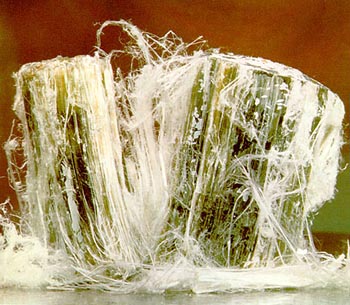
"Asbestos" is not a mineral in itself. It is a collective term given to a group of minerals whose crystals occur in fibrous forms. The term "asbestos" was adopted for commercial identification.
The six minerals commonly referred to as asbestos come from two distinct groups of minerals. One group is known as serpentines (chrysotile, white asbestos); while the other group is the amphiboles (amosite, brown asbestos; Crocidolite, blue asbestos; Anthophyllite; Tremolite; and Actinolite). While both are silicate minerals, the two groups are chemically and mineralogically distinct.
Chrysotile
Chrysotile is a sheet silicate which is formed as a very thin rolled sheet. The sheet is about 8 angstoms thick (0.8 nanometers thick). It is composed of a sandwich of magnesium and silica. In the lung, the acid environment of the macrophage scavenger cell quickly breaks apart the sheet structure causing the fiber to decompose into small pieces. These pieces can then be readily cleared from the lung. If the fiber is swallowed and ingested it is attacked by the even stronger acid environment (hydrochloric acid, PH 2) in the stomach.
Chrysotile has been known for over 2000 years, being used initially for cremation cloths, oil lamp wicks and other textiles. But, it is only in the 19th Century that Chrysotile was first mined commercially in the Urals (Russia), Italy and Canada.
Amphiboles
This is in contrast to the amphibole asbestos fibers which are formed as solid rods/fibers. The structure of an amphibole is a double chain of silicate tetrahedral which makes it very strong and durable. The external surface of the crystal structures of the amphiboles is quartz-like, and has the chemical resistance of quartz. The amphibole fibers have negligible solubility at any pH that might be encountered.
All these fibres are non-flammable. The major difference between chrysotile and amphiboles is related to its chemical composition, its acid-resistant properties and its effects on health. In contrast with amphiboles, chrysotile does not persist in the lungs after inhalation; it is quickly eliminated by the body. A prolonged exposure to high concentrations of chrysotile fibres is required for a clinical manifestation of pulmonary damage to appear. In the past, such high exposures were frequent; it is no longer the case today. On the other hand, because of their toxicity and their high biopersistence, amphiboles are mainly responsible for mesothelioma and pulmonary diseases even caused after a short or moderate exposure.
From Asbestos to Chrysotile
Today, chrysotile is the only asbestos fibre commercialized. The industry now only markets dense and non-friable materials in which the chrysotile fibre is encapsulated in a matrix of either cement or resin. These products include chrysotile cement building materials, friction materials, gaskets and certain plastics.
From Asbestos to Chrysotile
Current asbestos products are as different from the old ones as night and day. Today, only one type of asbestos is offered: chrysotile. In addition, the industry now only markets dense and non-friable materials in which the chrysotile fibre is encapsulated in a matrix of either cement or resin. These modern products include chrysotile-cement building materials, friction materials, gaskets and certain plastics. The old products, principally low-density insulation materials, were very dusty and crumbled under hand pressure. Unlike today's products, they often contained amphibole fibres (crocidolite and amosite).
Chrysotile: controlled use = safety
Chrysotile is a less dusty material and is more easily eliminated from the human body than amphiboles. The manufacture and use of modern products are safe as demonstrated by studies of workers exposed to much higher dust levels than in today's controlled factories which show no excess lung cancer or mesothelioma (cancer of the pleura).
There is more scientific evidence showing that asbestos-induced lung cancer, like fibrosis (asbestosis), is a threshold phenomenon. Moreover, studies confirms that very few cases of mesothelioma have been reliably attributed to chrysotile, despite the many thousands of workers who in the past have had massive and prolonged exposures. Mesotheliomas linked to exposure to asbestos are associated with amphibole fibres.
It is now known that in modern chrysotile manufacturing plants, at today's dust levels (0,5 to 1,0 fibres per mililitre) the risks, if any, are so low as to be undetectable. This is what is called a practical threshold.
Chrysotile-cement: a safe, high-quality product
90% of the world production of chrysotile is used in the manufacture of chrysotile-cement, in the form of pipes, sheets and shingles. These products are used in some sixty industrialized and developing countries.
Chrysotile-cement is valued principally for its excellent cost effectiveness and durability. Manufacture of this material requires the import of only small quantities of fibre, the other raw materials (portland cement, water) being easily available locally. Moreover, the manufacturing technology requires little investment and consumes less energy than production methods for competing products.
According to a group of experts convened by the World Health Organization (WHO - Oxford, 1989), chrysotile-cement products do not present risks of any significance to public health or the environment. Moreover, workers in this industry, whether employed in the manufacture, installation or removal of materials, are not exposed to any detectable risk when effective prevention and control measures are applied.
Why the controversy?
The real problem: old, poorly controlled products
Alarming reports of the rise in diseases linked to asbestos, combined with concern over the presence of asbestos insulation in buildings, have triggered intense controversy in Europe, especially in northern countries which were heavy users of friable asbestos insulation.
Because of the latency period between massive exposure and the appearance of diseases, it will take many more years before we see the health benefits of the prohibition of amphiboles and friable asbestos products which began in the 70's and of the regulations which now impose strict factory controls.
Do in-place friable asbestos insulation materials pose a threat to public health?
Numerous studies of buildings containing friable asbestos insulation materials demonstrate that air-borne dust levels within these buildings are not significantly different than in outside ambient air (0.1 to 1 fibres/litre). As a result, the U.S. Environmental Protection Agency (EPA) and the government authorities of several countries have therefore concluded that when in good condition, these materials do not pose a health problem to the occupants.
However, management programmes, which include inspections and corrective measures whenever necessary, are recommended for buildings containing asbestos insulation materials. Moreover, all maintenance workers must have access to adequate safety equipment and receive intensive training and information programs to ensure correct work practices are followed when handling these materials. Removal of asbestos insulation should be considered a measure of last resort, and undertaken only when the material is beyond repair or at the time of major renovation work or building demolition.
Asbestos removal = danger
Banning chrysotile-cement will not resolve the problem of friable insulation in buildings. It may, however, contribute to unwarranted public paranoia and a rush to initiate unnecessary and potentially dangerous removal work. Asbestos removal is a very costly operation which must be conducted by highly specialized contractors and workers. Hasty elimination of asbestos insulation considerably increases the probability that controls will not be adequately enforced, thus allowing excessive airborne asbestos dust and presenting a high risk not only for the workers, but for building occupants as well. Moreover, removal can create a new danger. Replacement products contain natural or synthetic fibres that can be hazardous as well. However, unlike for chrysotile, few countries have introduced appropriate regulations for these substitute materials.
Controlled use
While industrial development contributes to the well-being of society, it has also brought us numerous potentially hazardous products which we use daily and which are far more dangerous than chrysotile. In order to safely benefit from these products, we introduce standards and develop technologies and work methods which constitute what we call controlled use. The principle dictates that when the risks associated with a product cannot be controlled, its use should be discontinued; this was the rationale for prohibiting the use of amphibole asbestos fibres and friable asbestos products. Conversely, chrysotile and its non-friable products, such as chrysotile-cement, can be used safely when properly controlled throughout the product life-cycle. This is the position taken by the governments of Canada and Québec, regarding not only chrysotile asbestos, but all minerals and metals.
Where is chrysotile found?
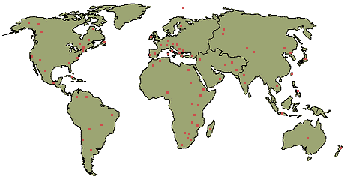
Chrysotile and the other varieties of asbestos are found in practically every country in the world, but generally not in quantities or quality that allow commercial exploitation. Nevertheless, significant deposits of chrysotile and other asbestos type have been identified in more than 60 countries, many of them have been mined or are still in exploitation.
Main occurence of chrysotile and other varieties of asbestos:
Production and Consumption
World production
| Estimated production (tonnes) for 1999 |
| Russia |
870 000 |
| China |
360 000 |
| Canada |
220 000 |
| Brazil |
210 000 |
| Kazakhstan |
200 000 |
| Zimbabwe |
170 000 |
| Other |
50 000 |
| Total |
2 080 000 |
| Sources: Natural Resources Canada, U.S. Geological Survey, The Chrysotile Institute |
|
World consumption
| Estimated consumption (tonnes) for 2003 |
| Far East |
880 000 |
| Russia and Central Asia |
530 000 |
| Middle East and Indian sub-continent |
320 000 |
| Africa |
80 000 |
| Central and South America |
180 000 |
| North America |
50 000 |
| Europe |
40 000 |
| Total |
2 080 000 |
| Source: The Chrysotile Institute |
|
|